Publication Alert: GPR15L counteracts colitis by reshaping the intestinal microbiome
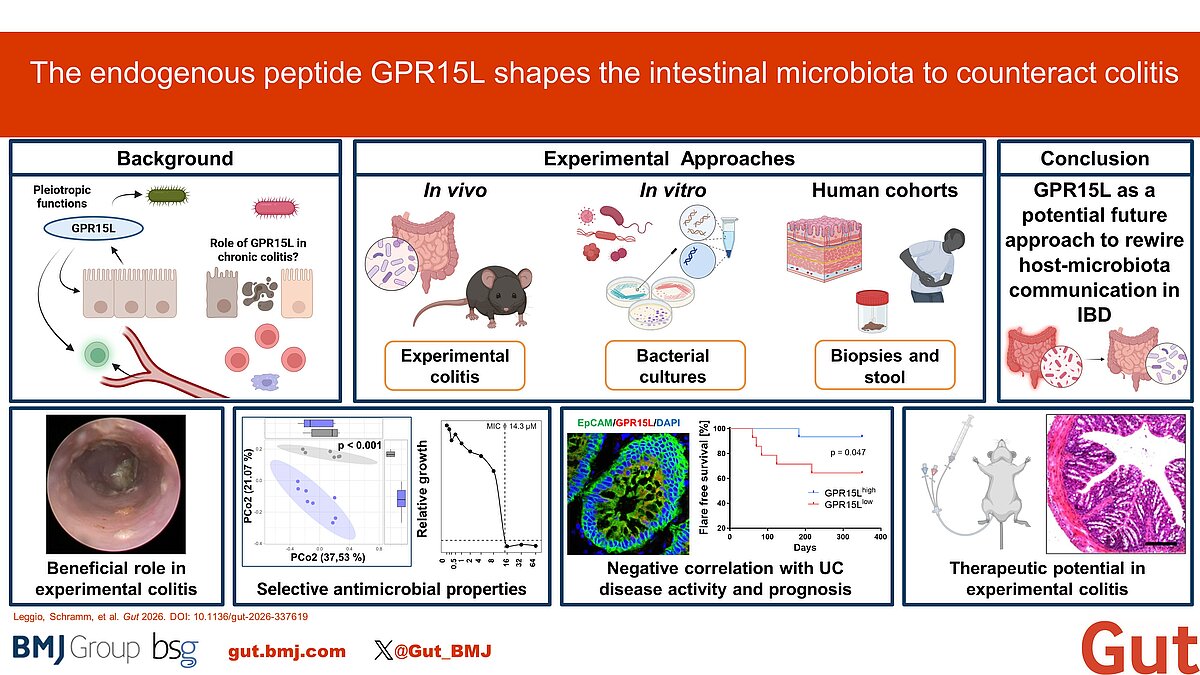
Source: Leggio et al., 2026, Gut
GPR15L has been characterized as a homing signal that engages the receptor GPR15 to mediate lymphocyte trafficking to the large intestine, a process implicated in the pathogenesis of colitis. A research team led by Prof. Dr. Dr. Sebastian Zundler, project leader of P13 within the Collaborative Research Center TRR 417, set out to test whether GPR15L promotes disease via this recruitment axis. The results, published recently in Gut, revealed a different mechanism.
Together with fellow TRR 417 members Dr. Tanja M. Müller (P13), Dr. Li-Juan Liu (P13), Prof. Dr. Claudia Günther (P06), Prof. Dr. Kai Hildner (P15), Prof. Dr. Markus Neurath (P09) and further collaborators, the team confirmed that GPR15L indeed counteracts experimental colitis in mice, however independently of GPR15 and lymphocyte recruitment. Instead, the protective effect was mediated by alterations in the intestinal microbiome: GPR15L acts as an antimicrobial peptide, shifting microbial composition in the large intestine of both mice and humans toward a homeostatic, disease-protective state. Commensal bacteria with protective functions were enriched in the presence of GPR15L while pathogenic bacteria were decreased. In patient biopsies, GPR15L expression was decreased during active inflammation and correlated with reduced microbial diversity and poorer flare-free survival.
These findings establish a second, mechanistically distinct function for a molecule previously defined by its role in lymphocyte homing. Therapeutic options have so far been limited to mitigating downstream immunological responses. Hence, topical application of GPR15L presents a promising novel therapeutic strategy.
Within the TRR 417 project P13, Sebastian Zundler, Tanja Müller and their team are currently exploring how GPR15L shapes the tumor microenvironment in colorectal cancer through its effects on both T cell recruitment and the intestinal microbiota.
Link to the publication: https://gut.bmj.com/content/early/2026/05/28/gutjnl-2025-337619.info